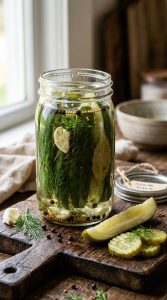
A great refrigerator dill pickle delivers a distinct, sharp snap upon biting, followed by a bright wave of garlic, fresh herbs, and balanced acidity. Making quick pickles at home requires minimal effort, bypasses the precise processing demands of traditional heat-canned preserving, and yields a fresh cucumber crunch that store-bought varieties rarely match. This method relies on a straightforward hot brine poured over tightly packed fresh cucumbers and spices, creating a batch of crisp, garlic-forward pickles in under twenty minutes of active time.
Because these pickles are kept in the refrigerator rather than shelf-stored, the cucumbers maintain their vibrant green color and firm cell structure. They serve as a vibrant contrast alongside rich meats, stacked inside sandwiches, or simply eaten straight from the jar as an icy, refreshing snack.
Recipe Overview
- Prep time: 15 minutes
- Cook time: 5 minutes
- Total time: 20 minutes (plus 1 hour cooling and 24 hours chilling)
- Servings/Yield: 2 quart jars (approx. 16 servings, 2 spears per serving)
- Difficulty: Easy
- Equipment needed: Two 1-quart (1-liter) wide-mouth glass jars with lids, medium non-reactive saucepan (stainless steel or enameled), chef’s knife, cutting board, liquid measuring cup, measuring spoons, ladle, small funnel (optional)
Ingredients
Note: Quantities are scaled for two 1-quart (1-liter) canning jars.
- Pickling cucumbers (such as Kirby): 2 pounds (900g), firm, washed thoroughly
- Water: 2 cups (480ml)
- Distilled white vinegar (5% acidity): 1 1/2 cups (360ml)
- Apple cider vinegar (5% acidity): 1/2 cup (120ml)
- Kosher salt (Diamond Crystal): 2 tablespoons (18g) — if using Morton’s kosher salt, use 1 1/2 tablespoons (18g)
- Granulated sugar: 1 tablespoon (12g) (optional; balances acidity without making pickles sweet)
- Fresh dill: 1 large bunch (approx. 1 ounce / 30g), sprigs and stems coarsely chopped
- Garlic: 6 large cloves, peeled and lightly smashed
- Whole black peppercorns: 1 1/2 teaspoons (4g)
- Whole mustard seeds: 1 teaspoon (3g)
- Crushed red pepper flakes: 1/2 teaspoon (1g) (optional, for mild heat)
- Dill seeds: 1/2 teaspoon (1.5g) (optional, adds deeper dry-spice aromatic notes)
Step-by-Step Instructions
- Prepare the jars and cucumbers: Wash two wide-mouth 1-quart glass jars and their lids thoroughly with warm, soapy water. Rinse well and dry completely. Trim approximately 1/16 inch off the blossom end of each cucumber (the end opposite the stem).
Note: The blossom end contains enzymes that can soften the pickles during storage.
Slice cucumbers lengthwise into quarter-inch spears, or horizontally into quarter-inch thick chips. - Distribute the aromatics: Divide the smashed garlic cloves, fresh dill sprigs, black peppercorns, mustard seeds, crushed red pepper flakes (if using), and dill seeds (if using) equally between the two prepared glass jars.
- Pack the cucumbers tightly: Stand the cucumber spears vertically in the jars over the aromatics, packing them as tightly as possible without crushing them. If making chips, layer them firmly up to 1/2 inch (1.2 cm) below the rim of the jars. Packing tightly prevents the cucumbers from floating once the brine is added.
- Prepare the brine: In a medium stainless steel or non-reactive saucepan, combine the water, distilled white vinegar, apple cider vinegar, kosher salt, and granulated sugar (if using). Place over medium-high heat and bring to a gentle boil, stirring occasionally for 2 to 3 minutes until the salt and sugar dissolve completely. Remove the brine from the heat.
- Ladle the brine: Place a funnel over the first jar. Carefully pour the hot liquid over the cucumbers, leaving 1/2 inch (1.2 cm) of empty space at the top of the jar. Repeat with the second jar, ensuring the spices and herbs in the bottom remain submerged.
- Release air bubbles and seal: Gently tap the bottom of each jar on a cutting board or kitchen towel to encourage trapped air bubbles to rise to the surface. Use a clean utensil to slide down the inside edge of the jar if bubbles remain. Top off with extra hot brine if necessary to keep all cucumber surfaces covered.
- Cool and refrigerate: Allow the uncovered jars to stand at room temperature until cool to the touch, about 1 hour. Place the lids on tightly. Transfer the jars to the refrigerator. Allow the pickles to cure for at least 24 hours before opening; peak flavor and texture develop between day 3 and day 7.
Expert Tips for Crisp Pickles
- Select small, firm cucumbers: Look for Kirby or pickling cucumbers that feel rigid with no give when squeezed. Standard English or garden cucumbers have high water content and thin skins, which turn soft quickly in brine.
- Use cold water pre-soak (optional): For maximum crispness, submerge whole cucumbers in a bowl of ice water for 30 to 60 minutes before trimming and slicing. Dry them completely before packing into jars.
- Mind the salt type: Standard table salt contains non-caking agents and iodine, which can turn the brine cloudy and impart a slightly metallic flavor. Stick to pure kosher salt or pickling salt.
- Keep them submerged: Cucumbers exposed to air above the liquid level can soften or discolor. Ensure the brine completely covers the vegetables.
Substitutions and Variations
- Spicy Dill Pickles: Add 1 fresh jalapeño or habanero pepper, sliced thin with seeds intact, split between the two jars along with the garlic.
- Vinegar Adjustment: You can replace the apple cider vinegar entirely with distilled white vinegar for a sharper, cleaner bite. Keep total liquid volume and vinegar strength (5% acidity) consistent.
- Herb Enhancements: Add 2 bay leaves (1 per jar) or a few sprigs of fresh coriander or target whole coriander seeds (1/2 teaspoon per jar) to complement the fresh dill.
- Other Vegetables: This exact brine ratio works well with sliced green tomatoes, trimmed green beans, thinly sliced radishes, or small cauliflower florets.
Storage Guidance
- Refrigeration: These are fresh refrigerator pickles and are not shelf-stable. Keep jars stored in the refrigerator at or below 40°F (4°C) at all times.
- Storage Duration: Pickles will maintain optimal crispness and flavor for up to 1 month. After one month, they remain safe to consume as long as kept cold, but texture will gradually soften.
- Freezing: Freezing quick pickles is not recommended, as ice crystals damage the cucumber cell structure, leading to soft, mushy slices upon thawing.
Nutrition Information
Estimated values per serving (2 pickle spears, approx. 50g):
| Nutriente | Quantidade |
|---|---|
| Calorias | 12 kcal |
| Total Fat | 0.1g |
| Sodium | 380mg |
| Total Carbohydrates | 2.5g |
| Dietary Fiber | 0.6g |
| Sugars | 1.2g |
| Protein | 0.4g |
Frequently Asked Questions
Why did my pickles turn soft instead of crisp?
Soft pickles usually result from using older cucumbers, omitting the step to trim the blossom end, or using water that was boiling hot when added to delicate slices. Starting with chilled, fresh Kirby cucumbers and removing the blossom tip prevents softening enzymes from breaking down pectin.
Can I reduce the salt in this recipe?
In refrigerator pickling, salt acts primarily as a flavor enhancer and helps draw out excess water from the vegetable cells to retain crispness. While slight reductions are possible, decreasing salt significantly will yield less crunchy pickles with a flatter flavor profile.
Do I need to heat the brine before pouring?
Yes. Heating the brine dissolves the salt and sugar quickly while helping the aromatics—such as garlic, mustard seed, and peppercorns—bloom and infuse their flavors into the liquid much faster than cold liquid would allow.
How soon can I eat these quick pickles?
While they are technically edible as soon as they cool, the flavor penetrates only the outer layer in the first few hours. Waiting 24 to 72 hours allows the garlic, dill, and acid balance to fully penetrate to the core of each spear.
Serving Suggestions
Serve chilled dill pickle spears alongside grilled burgers, smoked brisket, pulled pork sandwiches, or deli turkey subs. Chopped finely, these pickles make an excellent base for homemade tartar sauce or classic potato salad, adding balanced acidity and crunch to creamy dressings.