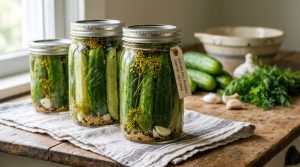
A classic Kosher dill pickle is defined by its bold garlic presence, clean dill flavor, and firm, satisfying snap. Making shelf-stable Kosher dills at home using a standard water bath canner preserves the peak harvest of summer cucumbers so you can enjoy crisp, tangy pickles throughout the entire year.
Achieving commercial-grade crunch in home-canned pickles requires standard food safety practices paired with specific culinary techniques. This recipe relies on an equal ratio of water to 5% acid vinegar, pure canning salt to keep the brine clear, and fresh aromatics. By removing the blossom end of the cucumber and utilizing proper thermal processing times, you will prevent soft or hollow pickles while maintaining safe acidity levels for shelf storage.
Recipe Overview
- Prep time: 35 minutes
- Cook/Processing time: 10 minutes
- Total time: 45 minutes (plus 24-hour cooling and 3-week curing time)
- Yield: 4 pint (500 ml) jars (16 servings, approx. 2 spears per serving)
- Difficulty: Intermediate
- Equipment needed: Water bath canner with rack, 4 pint wide-mouth mason jars with new lids and screw bands, non-reactive stainless steel or enameled saucepan, jar lifter, canning funnel, headspace tool or plastic ruler, clean kitchen towels.
Ingredients
Brine Solution
- 3 cups (710 ml) distilled white vinegar (5% acidity)
- 3 cups (710 ml) non-chlorinated water
- 1/4 cup (60 g) canning and pickling salt (do not use iodized table salt)
Pickling Vegetables & Aromatics
- 3 to 3.5 lbs (1.4 to 1.6 kg) small, fresh Kirby pickling cucumbers (3 to 4 inches in length)
- 8 medium garlic cloves, peeled and lightly crushed
- 4 fresh dill heads (or 8 sprigs fresh green dill weed with seed heads)
- 2 tsp (6 g) whole yellow mustard seeds
- 1 tsp (3 g) whole black peppercorns
- 1/2 tsp (1 g) crushed red pepper flakes (optional, for mild heat)
- 1/2 tsp calcium chloride granules (such as Ball Pickle Crisp), divided (optional, 1/8 tsp per pint jar for extra firmness)
Step-by-Step Instructions
- Prepare the Canning Equipment:
Inspect four pint jars for chips or cracks. Wash jars, lids, and bands in warm, soapy water and rinse thoroughly. Place the clean jars upright into your water bath canner, fill the canner with water until the jars are covered by at least 1 inch of water, and heat to a simmer (180°F / 82°C). Keep jars hot until ready to pack. Place new lids in a warm bowl of water (do not boil). - Prepare the Cucumbers:
Wash cucumbers thoroughly in cold running water to remove dirt. Slice 1/16-inch off the blossom end of each cucumber and discard it. The blossom end contains enzymes that can cause the finished pickles to become soft. Leave cucumbers whole, or cut length-wise into quarter-inch spears or half-inch round coins, keeping dimensions consistent per jar. - Prepare the Brine:
In a non-reactive stainless steel saucepan, combine the 3 cups of distilled white vinegar, 3 cups of water, and 1/4 cup of canning salt. Bring the mixture to a full rolling boil over medium-high heat, stirring until the salt completely dissolves. Turn heat to low and cover to keep the brine hot while packing. - Pack the Jars:
Use a jar lifter to remove one hot jar from the canner, draining water back into the kettle. Place the hot jar on a towel-lined counter. Into the bottom of the jar, add:- 2 crushed garlic cloves
- 1 fresh dill head (or 2 sprigs dill weed)
- 1/2 tsp mustard seeds
- 1/4 tsp black peppercorns
- 1/8 tsp red pepper flakes (if using)
- 1/8 tsp calcium chloride (if using)
Pack cucumbers tightly into the jar, standing spears vertically if cut, leaving sufficient space at the top. Pack tightly enough so they will not float, but take care not to crush the cucumbers.
- Ladle the Hot Brine:
Place a canning funnel over the packed jar. Ladle hot brine into the jar, leaving exactly 1/2-inch (1.2 cm) of headspace between the top of the liquid and the rim of the jar. - Remove Air Bubbles and Adjust Headspace:
Slide a plastic bubble remover or utensil down the inside walls of the jar to release trapped air pockets. Re-measure headspace. If needed, add more hot brine to restore the 1/2-inch space. - Seal the Jars:
Wipe the jar rim with a damp, clean paper towel to remove any brine or salt residue. Center a warm lid over the rim, apply the screw band, and turn until finger-tip tight (do not over-tighten, as steam must escape during processing). - Process in Water Bath:
Repeat the packing process for the remaining jars. Use the jar lifter to lower the filled jars into the boiling water bath canner. Ensure the water level is at least 1 to 2 inches above the jar tops. Cover the canner with a lid and bring the water to a full rolling boil. Process pint jars for 10 minutes at a full boil (adjusting for altitude if necessary). - Cool and Test Seals:
When processing time is complete, turn off the heat, remove the canner lid, and allow jars to sit in the water for 5 minutes. Carefully lift jars straight up without tilting and transfer them to a towel-lined countertop, leaving 1 to 2 inches of space between jars. Allow them to cool undisturbed for 12 to 24 hours. You should hear a distinct “ping” sound as the vacuum seals form. - Check Seals and Store:
After 24 hours, test seals by pressing the center of each lid. If the lid is firm and does not flex, it is sealed. Remove screw bands, clean jar exterior if sticky, label with date, and store in a cool, dark place. Wait 3 to 4 weeks before opening to allow the garlic and dill flavors to fully penetrate the cucumbers.
Expert Tips for Crisp Pickles
- Trim the Blossom Ends: The blossom end of the cucumber contains enzymes (enzymatic softeners) that break down pectin. Trimming just 1/16th of an inch off the tip prevents premature softening.
- Use Fresh Cucumbers: Pickles should be canned within 24 hours of harvest. Older cucumbers lose moisture and structural crispness, resulting in hollow or rubbery pickles.
- Never Alter Acidity Ratios: Standard water bath canning requires a minimum 5% acidity vinegar level. Always maintain a minimum ratio of 1 part 5% acid vinegar to 1 part water. Never reduce vinegar amounts, as this compromises safety against foodborne pathogens.
- Select Pure Canning Salt: Table salt contains iodine and anti-caking additives. Iodine will turn the pickles dark, and anti-caking agents will make the clear brine cloudy and leave sediment at the bottom of the jar.
Substitutions & Variations
- Spicy Kosher Dills: Add 1 to 2 fresh jalapeño or habanero peppers (sliced in half length-wise) per pint jar along with the garlic and spices.
- Apple Cider Vinegar Base: You can replace distilled white vinegar (5% acidity) with raw or filtered apple cider vinegar, provided it is verified at 5% acidity. This produces a slightly softer, fruitier flavor profile with a golden brine.
- Grape Leaf Method: If calcium chloride is unavailable, place one clean, fresh, unsprayed grape leaf in the bottom of each jar. Natural tannins in grape leaves bind to cucumber pectins to preserve crunch.
Storage Guidance
- Unopened Jars: Properly processed and sealed jars of pickles can be stored in a cool, dark, dry environment (50°F–70°F / 10°C–21°C) for up to 12 to 18 months.
- Opened Jars: Once opened, store pickles submerged in their brine in the refrigerator. Consume within 4 to 6 weeks for optimal flavor and texture.
- Signs of Spoilage: If a jar loses its seal, exhibits bulging lids, displays cloudiness accompanied by off-odors, or shows active bubbling inside an unopened jar, discard the contents immediately.
Nutrition Information
Note: Nutrition values are estimates per serving based on 2 pickle spears (approx. 35g). Brine absorption varies.
| Nutrient | Amount per Serving |
|---|---|
| Calories | 8 kcal |
| Total Fat | 0 g |
| Sodium | 380 mg |
| Total Carbohydrates | 2 g |
| Dietary Fiber | 0.5 g |
| Sugars | 1 g |
| Protein | 0 g |
Frequently Asked Questions
Why are my home-canned pickles soft or mushy?
Soft pickles usually result from using cucumbers harvested several days prior, failing to trim the blossom ends, over-processing in the water bath, or using an improper vinegar-to-water balance. Using calcium chloride or fresh pickling cucumbers helps retain firmness.
Can I use this recipe for refrigerator pickles without processing?
Yes. If you prefer to skip the water bath canning step, simply pack the jars, pour the hot brine over the cucumbers, cool to room temperature, seal, and place directly in the refrigerator. They will be ready to eat in 48 hours and will keep refrigerated for up to 2 months.
Why is there white sediment at the bottom of my pickling jars?
White sediment can be caused by the starch released from cucumbers, anti-caking compounds present in standard table salt, or minerals in hard tap water. If you used pure pickling salt and followed proper safety procedures, white sediment from cucumber starch is harmless.
Why did my garlic cloves turn blue or green in the jar?
Garlic contains naturally occurring enzymes and sulfur compounds that can react with the acid in vinegar and trace minerals in water. This color shift is a harmless chemical reaction and does not change the flavor or safety of the pickles.
Serving Suggestions
Serve chilled alongside deli sandwiches, such as pastrami or corned beef on rye, smash burgers, or grilled cheeses. Chopped finely, these pickles make an excellent component in fresh potato salad, egg salad, or homemade tartar sauce. The leftover brine can be reserved and used as a marinade tenderizer for poultry or added to brine solutions for pork chops.