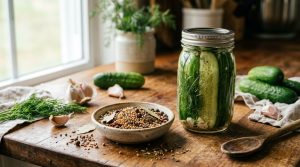
Making your own pickling spice blend elevates home canning from a routine preservation project into a craft. Store-bought pickling spices often rely heavily on inexpensive fillers like crushed cinnamon or whole cloves, which can easily overpower the clean, bright acidity of homemade dill pickles. By blending whole spices in balanced ratios, you control the aromatic depth, heat, and warmth of every batch you process.
This comprehensive guide provides both a master pickling spice mix recipe and a step-by-step procedure for safely processing crunchy dill pickles in a boiling water bath canner. The combination of pungent mustard seed, aromatic coriander, citrusy dill seed, and warm allspice delivers a crisp bite and complex flavor profile to cucumbers, green beans, or summer squash. Whether you are preserving a bumper crop of fresh garden cucumbers or prepping small batches from the farmers market, this formula ensures consistent acidity, safety, and crunch.
Recipe Overview
- Prep time: 25 minutes
- Cook time (processing): 10 minutes
- Total time: 35 minutes (plus 12–24 hours cooling time)
- Yield: 4 pint jars (473 ml each) of pickles, plus 1/2 cup (60 g) dry seasoning mix
- Difficulty: Intermediate
- Equipment needed: Boiling water bath canner with rack, 4 pint-sized canning jars with fresh lids and bands, jar lifter, bubble remover/headspace tool, non-reactive stainless steel saucepan, funnel, clean kitchen towels.
Ingredients
Master Dry Pickle Seasoning Blend
Yields approximately 1/2 cup (60 g) of dry spice mix. Extra spice mix can be stored in an airtight container for future batches.
- 2 tbsp (18 g) yellow mustard seeds
- 1 tbsp (9 g) brown mustard seeds
- 1 tbsp (9 g) dill seeds
- 1 tbsp (6 g) whole coriander seeds
- 1 tbsp (6 g) whole black peppercorns
- 1 tsp (2 g) whole allspice berries
- 1 tsp (2 g) celery seeds
- 1 tsp (2 g) crushed red pepper flakes (optional, for subtle background heat)
- 4 dried bay leaves, crumbled into small pieces
Dill Pickle Canning Setup
- 2 lbs (900 g) small, firm pickling cucumbers (such as Kirby), washed thoroughly
- 2 cups (480 ml) distilled white vinegar (5% acidity)
- 2 cups (480 ml) filtered water
- 2 tbsp (36 g) pickling salt (canning salt without iodine or anti-caking agents)
- 4 tbsp (24 g) prepared dry pickle seasoning blend (1 tbsp per pint jar)
- 4 medium garlic cloves, peeled and lightly crushed
- 4 sprigs fresh dill weed (optional, for extra herb flavor)
- 1 tsp calcium chloride granules (Pickle Crisp) divided into 1/4 tsp per jar (optional, for enhanced crispness)
Step-by-Step Canning Instructions
- Prepare the Dry Seasoning Blend: In a small bowl, combine the yellow mustard seeds, brown mustard seeds, dill seeds, coriander seeds, black peppercorns, allspice berries, celery seeds, red pepper flakes (if using), and crumbled bay leaves. Stir well to distribute the spices evenly. Set aside.
- Prepare the Canning Equipment: Place your water bath canner on the stove with the rack inside. Fill it half full with water and bring it to a simmer (around 180°F / 82°C). Inspect 4 pint-sized mason jars for chips or cracks. Wash jars, lids, and bands in hot, soapy water and rinse thoroughly. Submerge the clean jars in the simmering water to keep them warm until ready to pack.
- Prepare the Cucumbers: Wash the pickling cucumbers under cold running water. Slice off the blossom end of each cucumber by at least 1/16th of an inch (1.5 mm). The blossom end contains enzymes that can cause soft pickles. Leave the cucumbers whole, or cut them into halves, quarters (spears), or 1/4-inch slices according to your preference.
- Prepare the Pickling Brine: In a medium stainless steel or non-reactive saucepan, combine 2 cups (480 ml) distilled white vinegar, 2 cups (480 ml) filtered water, and 2 tbsp (36 g) pickling salt. Bring the mixture to a rolling boil over medium-high heat (212°F / 100°C), stirring until the salt completely dissolves. Reduce heat to low to keep the brine hot until ready to pour.
- Pack the Jars: Carefully remove warm jars from the canner using jar tongs and set them on a clean kitchen towel. Into the bottom of each warm jar, place 1 tbsp (6 g) of the dry pickle seasoning blend, 1 crushed garlic clove, 1 fresh dill sprig (if using), and 1/4 tsp of calcium chloride granules (if using). Pack the prepared cucumber spears tightly into the jars vertically, leaving enough space for brine coverage.
- Add Hot Brine and Set Headspace: Using a canning funnel, ladle the boiling brine over the cucumbers into each jar, leaving exactly 1/2 inch (1.25 cm) of headspace between the top of the liquid and the top rim of the jar.
- Remove Bubbles and Adjust Liquid: Slide a plastic bubble remover or non-metallic spatula down the inside edges of each jar to release trapped air bubbles. Re-measure the headspace and add a small amount of extra hot brine if necessary to maintain the 1/2-inch headspace.
- Wipe Rims and Apply Lids: Wipe the glass rims of each jar with a clean, damp paper towel to remove any moisture, brine residue, or seed particles. Place a clean lid flat onto each jar rim. Screw the metal band over the lid until it is fingertip-tight (do not over-tighten, as steam must escape during processing).
- Process in Water Bath: Lower the filled jars into the canner using your jar lifter. Ensure the water covers the jar tops by at least 1 to 2 inches (2.5 to 5 cm). Cover the canner with its lid and bring the water back to a full, rolling boil (212°F / 100°C). Once boiling, start a timer for 10 minutes (adjust for altitude if living above 1,000 feet / 305 meters).
- Cool and Test Seals: When processing time is complete, turn off the heat, remove the canner lid, and let the jars rest in the water for 5 minutes. Carefully lift the jars straight out of the water without tilting them and transfer them to a towel-lined surface. Allow the jars to cool undisturbed for 12 to 24 hours. You should hear a distinct “pop” sound as the vacuum seal forms. Press the center of each lid after 12 hours; if it does not flex up and down, the jar is properly sealed.
Expert Tips for Success
- Use standard 5% acidity vinegar: Always check the label on your white distilled vinegar or cider vinegar. Safe home canning depends on a minimum of 5% acidity to prevent bacterial growth. Never dilute your brine beyond the safe 1:1 ratio of water to vinegar tested in this recipe.
- Select fresh, firm cucumbers: Pickling cucumbers should ideally be canned within 24 hours of harvest. Salad cucumbers (like English or Persian varieties) have thinner skins and higher moisture content, which results in soggy pickles when canned.
- Trim blossom ends: The blossom end contains natural enzymes that break down pectin and soften the cucumber tissue during storage. Trimming this tip is an essential step for long-term crunch.
- Avoid iodized table salt: Standard table salt contains anti-caking additives and iodine, which will turn your pickling liquid cloudy and cause dark discoloration in your canned garlic and spices. Stick exclusively to pure pickling salt or additive-free coarse kosher salt.
- Toast whole spices lightly (optional): If you want a deeper, earthier spice profile for warm-spiced pickles, warm the whole spices in a dry skillet over low heat for 2 minutes until aromatic before mixing. Avoid scorching the mustard seeds.
Substitutions and Variations
- Spicy Dill Pickles: Increase the red pepper flakes in the spice blend to 1 tablespoon, or add 2 fresh habanero or jalapeño pepper slices directly into each jar before packing.
- Bread and Butter Pickles: Swap 1 cup of white vinegar for apple cider vinegar (5% acidity), add 1/2 cup of granulated sugar to the brine, and add 1/2 teaspoon of ground turmeric to the dry seasoning blend for bright yellow color and classic sweet flavor.
- Dill-Free Spice Blend: Replace the dill seeds with caraway seeds or extra coriander if you prefer classic European-style kosher spice profiles for pickled green beans, carrots, or asparagus.
- Vinegar Alternatives: Apple cider vinegar (5% acidity) can replace white distilled vinegar cup-for-cup. It provides a slightly sweeter, fruitier undertone, though it will darken the brine color slightly.
Storage and Shelf Life Guidance
Properly processed and sealed jars of pickles should be stored in a cool, dark, dry place such as a pantry or cellar. Maintain storage temperatures between 50°F and 70°F (10°C to 21°C) for optimal quality.
- Unopened Shelf Life: Vacuum-sealed jars maintain peak crispness, flavor, and color for up to 12 to 18 months. Pickles remain safe to eat beyond this timeframe as long as the seal remains intact, though physical crispness may decline gradually.
- Curing Time: For best flavor development, allow canned pickles to rest unopened in the pantry for at least 3 to 4 weeks before opening. This gives the pickling spice and garlic adequate time to penetrate the cucumbers completely.
- After Opening: Store opened jars in the refrigerator at or below 40°F (4°C) and consume within 3 to 4 weeks. Always use clean utensils to remove pickles from the jar to prevent introduction of bacteria.
- Freezing: Canned pickling brine and processed whole pickles do not freeze well; freezing causes the cell walls of cucumbers to collapse, resulting in mushy textures upon thawing.
Nutrition Information
Note: Nutrition values are reasonable estimates per serving (calculated as 2 pickling spears / approx. 30g). Brine absorption varies.
| Nutrient | Amount per Serving |
|---|---|
| Calories | 10 kcal |
| Total Fat | 0 g |
| Saturated Fat | 0 g |
| Sodium | 280 mg |
| Total Carbohydrates | 2 g |
| Dietary Fiber | 0.5 g |
| Sugars | 1 g |
| Protein | 0 g |
Frequently Asked Questions
Can I use this pickle seasoning for refrigerator pickles without a water bath canner?
Yes. You can pack fresh cucumbers and spices into glass containers, pour the hot salt-and-vinegar brine over them, let them cool to room temperature, and place them directly in the refrigerator. Refrigerator pickles bypass the heating step but must stay chilled continuously and consumed within 3 to 4 weeks.
Why are my canned pickles soft instead of crunchy?
Soft pickles generally stem from five factors: failing to cut off the blossom ends, using old or overgrown cucumbers, processing jars too long in the boiling water bath, using low-acidity vinegar, or storing jars in a hot room. Using calcium chloride (Pickle Crisp) and processing strictly for 10 minutes helps preserve crispness.
Why did my garlic turn blue or green inside the jar?
Garlic contains natural enzymes and sulfur compounds that react with the vinegar’s acid and trace minerals in water or salt. This color change is entirely harmless and safe to eat; it does not alter the flavor of your pickles.
Can I reduce the amount of vinegar in the brine recipe?
No. Maintaining a 1:1 ratio of water to 5% acidity vinegar is essential for water bath canning safety. Reducing vinegar lowers the acidity level, creating an environment where harmful pathogens could grow. Always follow tested acidity ratios for home preservation.
Serving Suggestions and Pairings
Serve these crisp dill pickles well-chilled straight from the refrigerator. Their snappy texture and punchy acidity make them an essential accompaniment to heavy, savory, or rich dishes.
Pair spears alongside smoked barbecue meats, smash burgers, pulled pork sandwiches, and deli pastrami on rye. Slice them into rounds to layer over grilled cheese sandwiches, finely dice them to stir into potato salad and deviled egg fillings, or feature them as a bright contrast on charcuterie boards featuring aged cheddar, cured salami, and coarse mustard.